
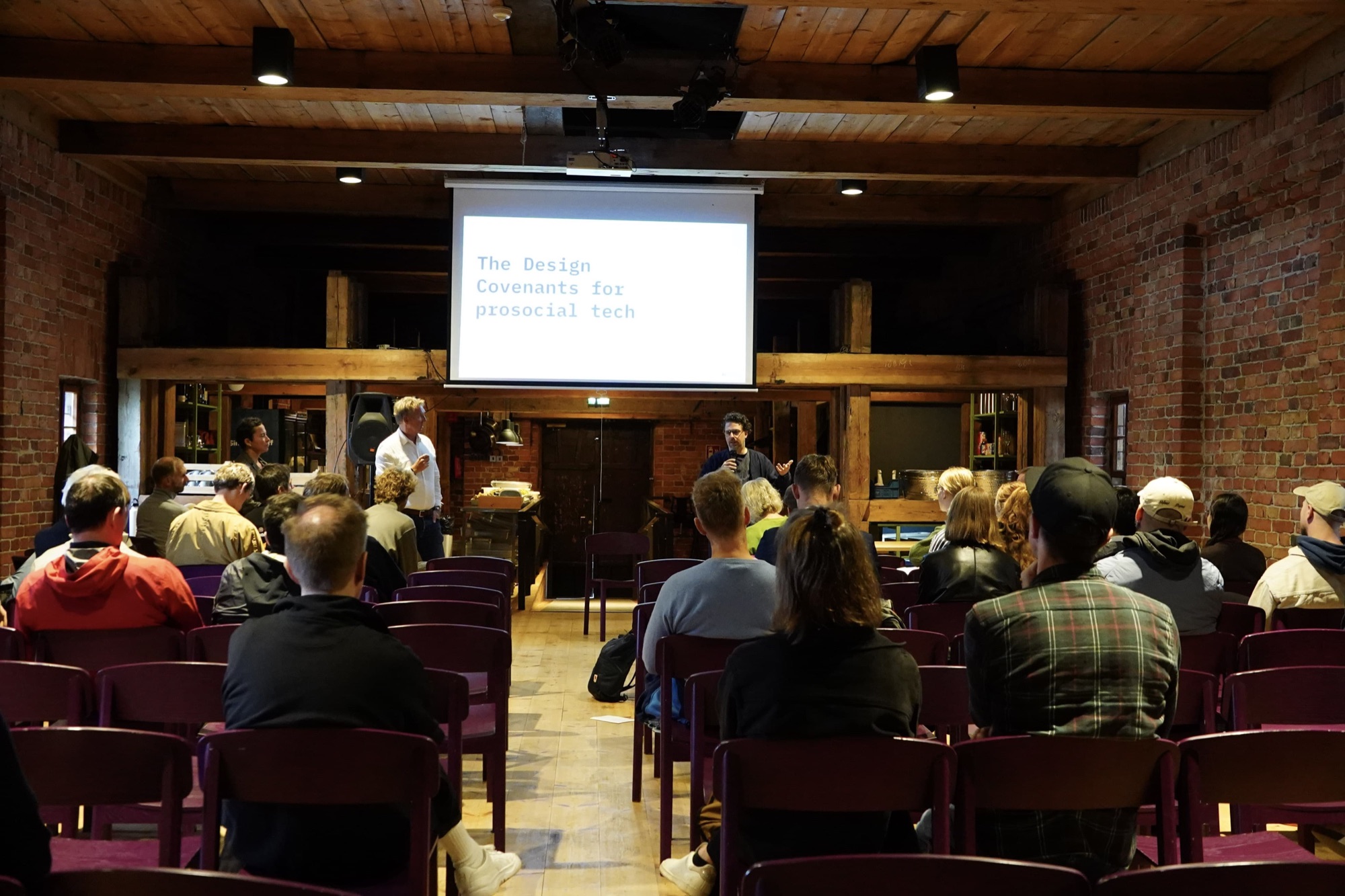
Five design covenants for pro-social tech – and why the words we use shape the platforms we build.
One of the core aims of the Rebuild project is to codify and elaborate a set of principles which should underpin European social platform design – principles which will, in theory and hopefully in practice, ensure that social platforms born from Europe will be built in ways which support and incentivise positive outcomes for users and wider society as well as business.
Simona Maschi, Marco Samarotti and Christian Lindholm have been part of the team across both Rebuild sessions helping to build and codify a new, future-facing paradigm for how to conceive of social platforms in the post-AI, post-agentic era.
As Christian explains, we are about to enter a new era of design which will require a new set of ways of thinking. If we accept – as seems probable, if not inevitable – that the next generation of social platforms will encompass both humans and agents, and that new platforms and products will emerge at a pace as-yet unseen, then, it is imperative that the thinking behind how they are constructed takes into account this new era and how to ensure that the actors within them, and the structures that maintain them, are focused on human wellbeing from the start.
The outcome has been what the team has defined as ‘design covenants for pro-social tech’; an attempt to come up with design principles which look to the future, and proactively establish processes which feel more thoughtful, more ethical than those which have characterised the past 20 years. The thinking behind the term ‘covenant’ is to create rules which are not only ‘nice to have’ but which imply a degree of commitment from participants that the principles will be adhered to, and that they can be measured and upheld.

Marco’s experience designing the Play Store at Google is where he first encountered the idea that the terminology and language can and does determine the evolution and function of systems – terminology drives metrics drives behaviour. Define something as a ‘shop’ and your metrics will be sales-related…but they won’t necessarily optimise for user satisfaction. Define it as a matchmaking service, and the quality of interactions will improve while perhaps sales will decline. These things matter.
At heart, this is a deeply philosophical question – from a Wittgensteinian point of view, language determines the parameters of what is possible and how, how systems function and how they break down.
Terminology drives metrics drives behaviour.
The first new principle alighted upon is ‘transparency of allegiance’ – that is, the service and its agent declare whose interests they serve, what their purpose is and how they are designed to achieve that – full, radical transparency about why a platform exists – in a meaningful rather than a PR sense.
The second is based on the idea of intentional human agency – that the human has to be involved in choosing, questioning and deciding, and has to be asked for consent before acting on a human’s behalf – without this, something crucial is lost.
Richness over reach is the third principle – exposing the user to different views and perspectives, voices and communities that they wouldn’t have found alone, and treating depth as a success criterion rather than scale. Personalisation is not the same as richness – after all, one could easily build a perfect filter bubble for oneself given the opportunity.
The fourth element proposed is ‘structural kindness’; that is, that kindness is a matter of structure, that it can be built into the mechanics of a system through definition and declaration. Stating clearly within a system’s infrastructure how benefits are weighed, whose interests are given primacy and how this is balanced and weighted, is crucial.
Personalisation is not the same as richness.
Sovereignty of human context is also considered vital; context, in the sense of memory, preferences, refusals and the like, belongs to the human.
A proven commitment to the principles would grant platforms and services the opportunity to display the Covenant Mark – a quality kitemark of sorts for social platforms which will give users the confidence that the systems they are interacting with and any AI components that exist within them are optimised for human flourishing rather than exploitation.
At this stage, of course, these are only principles – there is significant work which needs to happen to refine them, and to create a concrete set of processes so as to ensure that they can be translated into practical, measurable action. It is, though, an exciting new paradigm which can, if we build on it, help ensure that the future of European social platforms (whether agentically-enhanced or otherwise) is optimised towards principles that foster better outcomes for the Earth.