
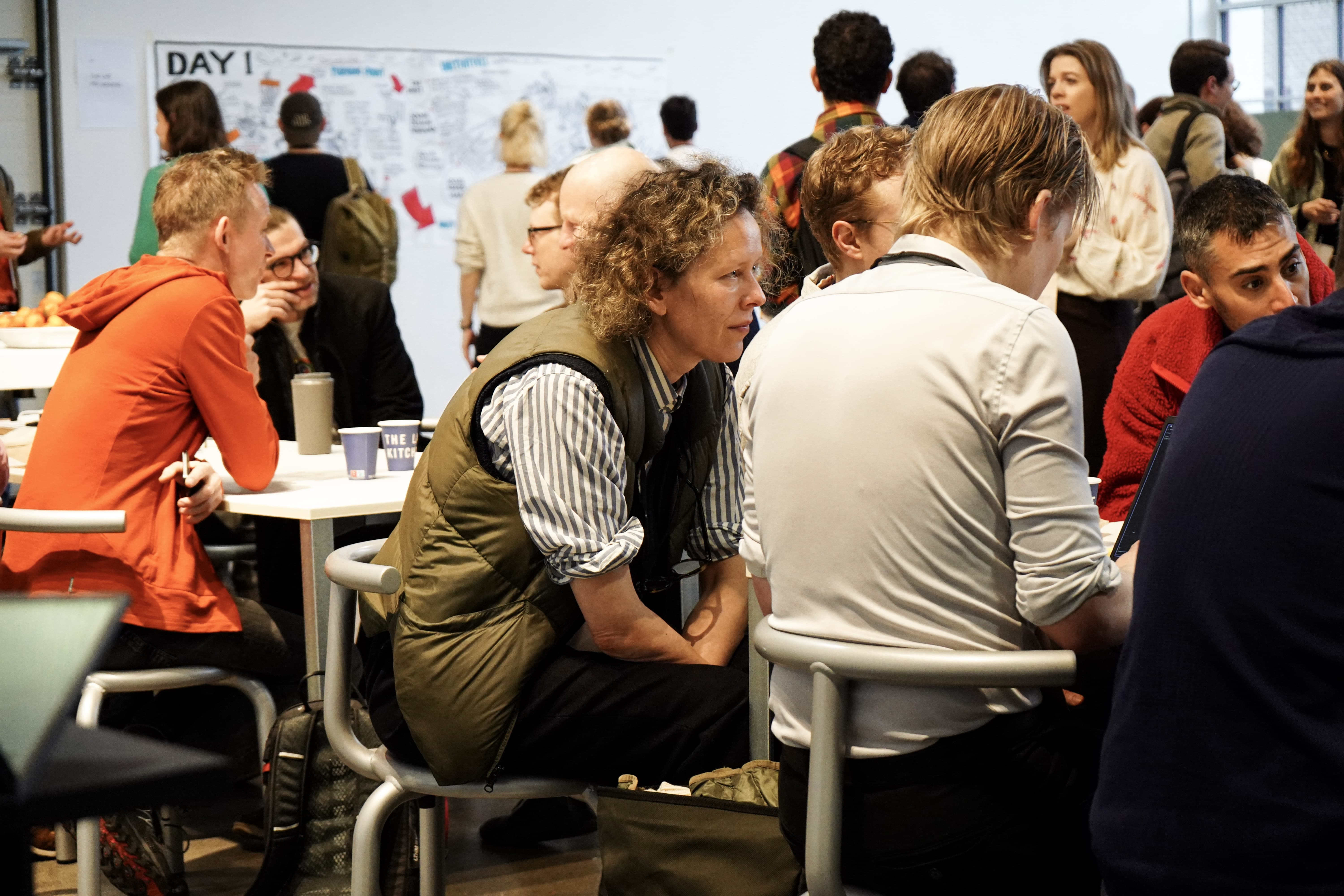
Katharina Birkenbach has spent 20 years watching tech design lose its playfulness
Three years ago, Katharina Birkenbach left her design job in tech to cycle 11,000 kilometres across Europe. "It was quite a long trip," she laughs, but she'd been working in the startup world for almost 20 years. "In the end it got a little bit repetitive," she explains, pointing to both the startup pipeline, from scale up to business, and the lack of variety in design patterns.
Those patterns hadn't been formed when she started working as a designer. She remembers her first role at agency-cum-foundation Mediamatic. Post graduation, with a visual communications degree in 2003, the job prospects were dire. So Katharina moved to Amsterdam for an internship at Mediamatic – they were developing their own CMS to help make storytelling websites for cultural foundations and organisations. "That was really nice," she smiles, "it was a whole variety of social networks, and it was about neighbourhoods."
“Because it wasn't bound to any venture capital money.”
Katharina Birkenbach
The thing that sticks in her mind is how "playful" it all was back then. "Because it wasn't bound to any venture capital money." Twenty years later the internet is pushing for that playful nature to return: netizens posting pleas to "make software playful again", "make the internet fun again", accompanied by examples of silly design quirks – like the bear mascot of a prototype webpage covering its eyes when you type in your password.
That playful nature was inherent to her location, Birkenbach says. "Amsterdam is really bold. I did designs that – if you proposed them nowadays – would not go through." But it was also a product of the time, she says, because the overly familiar design patterns of today hadn't been developed yet. "If you wanted to make a login, you had to almost reinvent the login, or you had to rethink because these patterns were not there," she says. "On the one hand, it's sad that this playfulness is lost, every app looks the same more or less, but at the same time it's a global design pattern language, people can recognise it and it's very easy for them to use stuff." There's good and bad to it. Christian Lindholm, speaking on the Designing Social Platforms panel at Rebuild1, calls it "of course design", because, of course, that's how it's going to work. But, as he suggests in the panel, what if we made design beautiful instead? Or, at least, different to what came before?
And, recapturing the playful nature of technology was an ambition that came up several times during Rebuild1. "We are building playgrounds, not casinos," read one sticky note on an early plan for the Rebuild Letter. And Linda Liukas, speaking on the same panel as Lindstrom, talked about her work exploring complex concepts – from AI algorithms to synthetic biology – through interactive playgrounds. Thomas Madsen-Mygdal added that the energy had been "sucked out" of the design world over the past few years. It has returned now, he said on the panel, but asked that if we are in the European social platform renaissance, "can we make a UX renaissance too?" While fellow panellist, Alexander Baumgardt, suggested designers take the lead from their early predecessors and start building their own tools. "There should be more injection of soul," he said.
Katharina Birkenbach is all for upending the system, but she has no plans – as of yet – to return to the tech world herself. "I'm studying landscape architecture, something that's designed to be quite detached from startups," she says. "I haven't touched much grass yet; it's more about shaping places where people come together in the real world." So she's now planting physical gardens, rather than sowing seeds in the digital realm.
“Possibly put them on a one-month bike trip, to let them see how to figure things out.”
Katharina Birkenbach
While on her bike trip, starting in Rome, through Italy, France, the UK, from Land's End to John O'Groats, then around the Shetland Islands, then all the way back to the Alps, she had a lot of time to think. "When you're on your bike for eight hours a day, it's very strange what things are popping up into your mind," she says. One thought was about the designers she'd left behind; if she ever had to hire someone again, she'd "possibly put them on a one-month bike trip, to let them see how to figure things out".