
Breaking down the essential elements that make social platforms work
Being social is about meeting and spending time with other people. Throughout history, social interaction has brought humans together. From the early days of social platforms, it also became possible to be and act socially online. Not limited by time zones or distance, all you needed was an internet connection, and it became possible to start building and cultivating relationships whenever and wherever you wanted to. The only thing constraining the building of relationships and the kinds of relationships was the service offered by a social platform. The type of relationships that can be formed online relies on different types of actions or even interactions: conversations, image sharing, personal profile presentations. Depending on the social platform, and its focus, many shapes of relationship building are possible.
Below, we present a social design framework that can support the understanding of social platforms: capturing and understanding the key characteristics of any platform. Our framework is the continuation of work by others; started by early pioneers such as Jyri Engeström, Matt Webb and Jack Schulze, formalised in academia by Kietzmann, Hermkens, McCarthy & Silvestre, and used by analysts in the honeycomb model. There are likely more people out there giving language to this space – and if you know of any, get in touch.
“Everything is expressed through relationships”
Piet Mondrian
As we’ve begun the rebuild of Europe’s social platforms, we believe that an updated framework can serve the current and next generation of builders. It is our intention that this conversation shouldn’t end here; we invite you to read, comment, improve and use it.
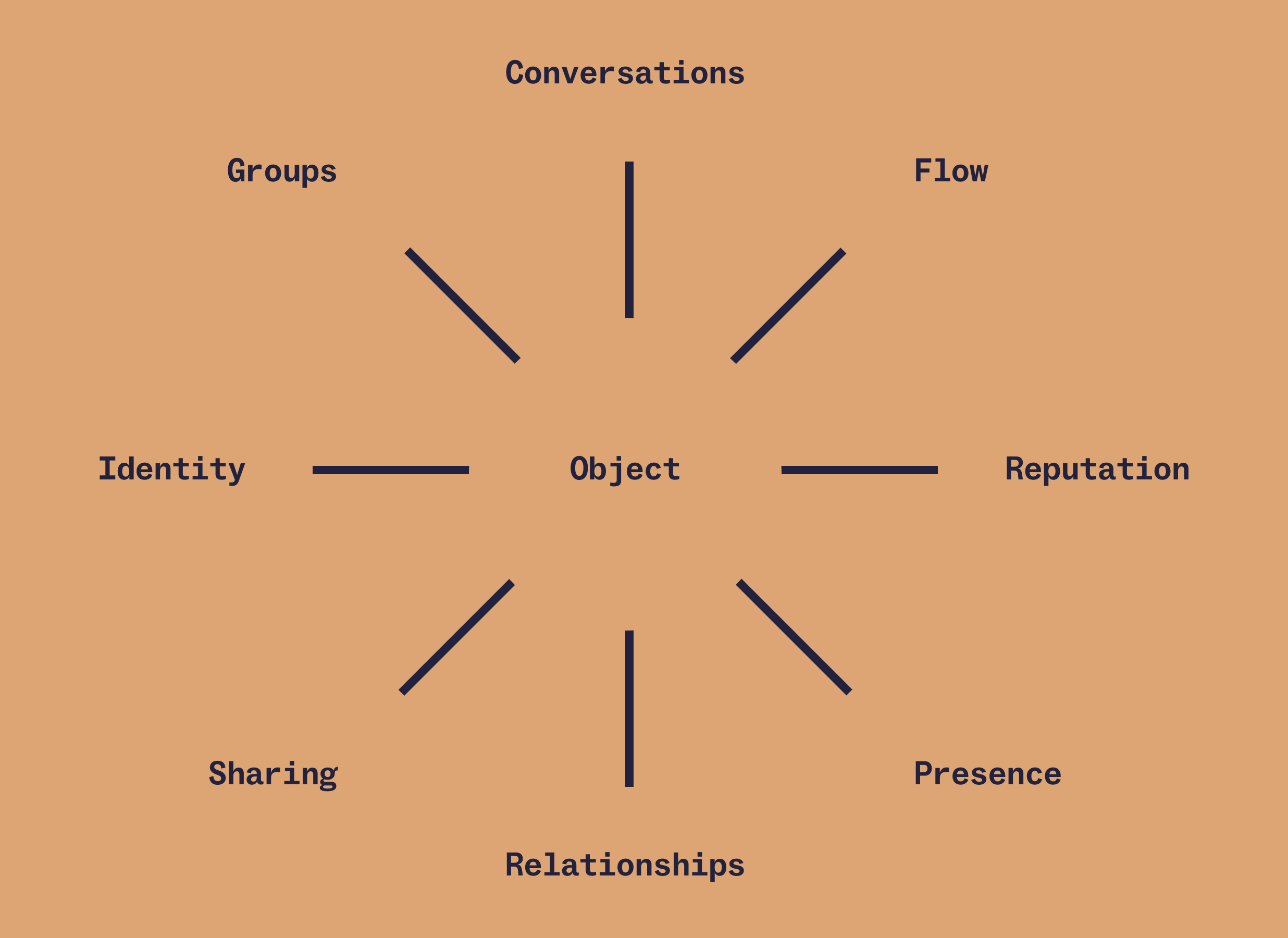
The framework consists of nine interchangeable elements, each one describing a function or aspect that a social platform can embody. Some platforms focus on many of the elements, and others specifically on one or two. In describing the elements, we’ve included references for recognisable terminology that delivers on key aspects of the elements.
Identity
The presentation of the online self. The expressions you make, the clothes you wear, the place you live, the language you use are, among other things, what define your identity. On a social platform, your identity is also related to how you present yourself. Usually this is through your profile; the image you choose to represent yourself and the text that describes who you are. Your identity is what you show everyone else, and also what you carry with you into interactions. It is what other people see when they click on or hover over your profile. Depending on the platform there are many variations of how to present your identity. Think: avatars, tags, names or handles, location, personal description, custom css/html, hyperlinks.
Conversations
The ability to communicate. Discussing, talking, singing, writing, reading, gesturing … communication takes many shapes. The same is true for social platforms where there are multiple ways to engage in conversation. The basic form of conversations is the interaction of users in an exchange of messages. This can be private between two people; in groups or multiple people commenting on the same activity. From platform to platform the format of the conversation varies. Think: direct messages, live chats, forum discussions, threads and replies, announcements, reactions, snapping, and pinning.
Sharing
The activity of distribution. When something is on your mind, you want to talk about it. Offline, you usually share something directly with another person or in a group. Online, you can share it on a platform. Whether it is videos, a live feed, a poll, images, or status updates, the platform provides the user with the option to share it in a space defined by the platform. The space of your choice also determines how long the shared content is available, who can interact, and how they can interact. Think: images, videos, stories, status updates, other media formats such as audio. Other users can engage with the shared material through conversations by reacting, commenting, reposting, editing, but shared material can also be repurposed and re-shared again. Think memes, edited stories, collages, collections.
Presence
The display of user presence. People who are highly engaged in neighbourhood communities, political parties, groups of friends and so forth gain attention for their activity. People remember if someone is always there, writing the minutes at a meeting, ensuring that friends get together, and so forth. They are also noticed when they're not present, for the same reasons. Social platforms have ways of displaying a person’s activity on the platform. Most common are displays of whether the user is online or offline, but many variations exist. Think: contribution counters, badges, time spent, location trackers, number of messages sent or received.
Relationships
The link between you and others. At a social gathering such as a party, a relevant question is usually: so how do you know that particular person? Understanding connections is part of understanding relationships, and building new ones. In our heads we have a fairly accurate idea of how we know people and from where. On social platforms our connections with other people can be displayed in ways defined by the platform. Some platforms focus on specific types of connections (e.g., business, shared interest) whereas others have broader inclusion, and some platforms provide additional layered ways to illustrate connections. For the most common types of connections think: followers, friends, and connections. Other variations include blogroll, members, matches. For layered connections think: close friends, mutual friends or mutual connections, but also platform-specific connections such as forum or group memberships.
Reputation
The markers of social standing. A person's reputation is linked to what others know about them: what they are known for and have done influences what people say about them. Usually reputation is linked to other people's perception of an individual or company. You don't know what people think or say about you, but you might, however, have an idea. On social platforms reputation can be linked to metrics, which give you as a user and other people a way of understanding reputation. These metrics can be illustrated in terms of reach, think: number of followers; skills; kudos and endorsements; history, think: date of joining a platform; credibility through verification; or social reputation, think: followers or connections in common.
Groups
The place of shared interest. If you're part of a community, you're part of a group with a shared interest. You can also be part of social groups, friends, study groups, sports clubs, neighbourhood communities and so forth. From the knitting community to the neighbourhood app, groups are how we organise ourselves around a common interest, both formally and informally. Social platforms allow users to shape the organising structure of group relationships in a digital space: to set the rules of conversation, sharing principles, conditions for membership, and usually giving administrator privileges to moderate the group's principles. Think: forums, community-based groups on platforms, platforms that specifically target group management, events and conversations, and specific platforms for group messaging.
Flow
The experience of attention. What did you do last week? Or last year? For most people, remembering our trips, conversations, books read, and social gatherings can be difficult beyond the recent past. However, some things remain clear in our memory and attention spans. Some milestones, events, or things we did remain clear memories in the the flow of life Social platforms provide ways for users to organise their attention, history, and interests – their activity on a platform. The flow of the platform is important for the user experience, it allows exploration of interests and discovery of new activities, and it can show the history of the user and other people on the platform. Think: timelines and feeds, history, books read and to read, on this day, places visited in terms of activity on a platform; and hashtags, collections, and but also think, swiping for matches or discovery functions.
Social objects
The centre of social engagement. Remember that restaurant you keep coming back to? That same board game that you always play with your friends? Why you go to the cinema with friends? Or join a book club? Social objects are what brings us together, what keeps us repeating the same activity. On social platforms the same rule applies: they come with a core function, the connecting experience that makes, and continues to make, the platform social – and a success. Examples include the thrill of a match on a dating platform or an image on a photo-sharing platform. A social object is the asset that engages people to use a particular platform and what makes them return. Think: jobs on LinkedIn or Xing, news on X, images or stories on Instagram or Facebook, comments on a subreddit, matches on a dating platform, or new messages on any messaging app.