
Felix Petersen on why you should build something that tastes good
We’re all nostalgic for the early 00s social scene, but multi-founder, investor and builder Felix Petersen was there. His first startup, Plazes, was a geosocial networking site, founded in 2005 and bought by Nokia in 2008. On stage at Rebuild 1, Petersen took his rapt audience through his own – quite psychologically taxing – journey from web 2.0 through to our current AI era, explaining why he’s continued building through every stage of the internet and how we can reinvigorate the internet’s social landscape.
“Let’s build home-cooked social,” he said during his keynote at the gathering. “And let’s build it in Europe.”
When Petersen says home-cooked, he’s referencing the fast-food nature of the global social platforms we’ve all grown accustomed to. “They pull us in, then spit us out a bit sadder and lonelier than before.” But that wasn’t the intention. When web 2.0 happened, there was a “Cambrian explosion of services,” he said on stage. “It was truly social in its best sense.” But these were social platforms, not social media. Europe has a unique base to be the place to make social … “social” again. “People come here to enjoy culture, they come here to enjoy our way of life,” Petersen says to us after his talk. “What we’re proud of in Europe, what we enjoy and what we sell to others is craftsmanship, knowing how to live life, having a more human society – at least talking about the best case scenario.”
“When building becomes free, taste becomes much more important.”
Felix Petersen
In short, Europeans have taste, and – as Petersen points out regarding the possibilities to vibe-code with AI – “when building becomes free, taste becomes much more important.” Vibe-coding gives everyone with a computer the ability to build, to build an at-least-pretty-basic version of an online service they desire for a fraction of the cost (or less) that was previously necessary – our value now comes from what we decide to create.
In contrast, scale no longer matters as much. We can build at a hyperlocal level, for a niche audience, and actually have something to say. “If you build things that the whole world should use, you need to be at the lowest common denominator,” he says, pointing to Facebook. “But if a teenager builds something for their group of friends, then it’s not universal – but that’s ok.”
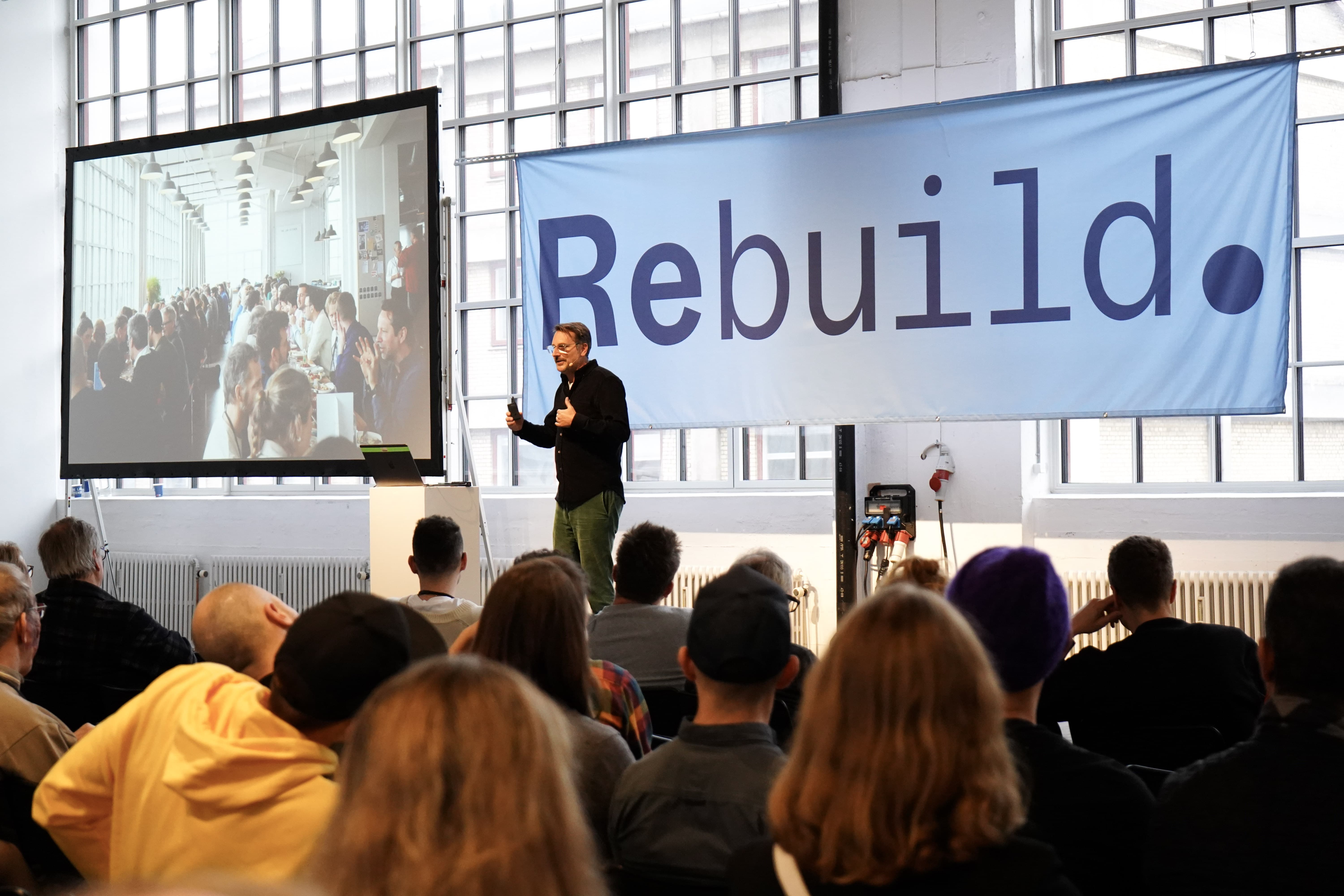
When Petersen talks about what AI has done for builders you can see the glimmer of excitement in his eyes. He understands the risks and the “enshittification” associated with it, pointing specifically to the addition of advertisement to ChatGPT. “But, at the same time, I can’t deny that when I first saw it I was like ‘fuck this is great.’”
When the age of AI began, not only did both the time and monetary cost of building go down, AI also allowed builders to think more about interoperability. You can now simply ask an AI agent to scrape your data from a service such as Google Maps, make sense of the data, and build an app based on it.
“I actually did that last weekend,” Petersen said on stage. He gets his phone out during our interview to show us how: he’s built an app that makes it possible to search through everything he’s ever bookmarked. The wild collection of dots, once unsorted and untagged, sprawled and overlapping across the world map, can now respond to queries like ‘techno in Berlin’ or ‘Lisbon ice cream’ (one of the listings is Gelateria Chantilly, a shop he opened himself, “it’s very good ice cream, you should check it out”).
“Retention is the only thing that matters in the beginning to understand if something works or it doesn’t”
Felix Petersen
Another benefit of this lower bar for builders, he says, is “if things are really cheap to build, you cling onto it less”. Vibe-coding effectively removes the sunk cost fallacy, which dictates that if you’re hand crafting something for three months, three years, you’re more likely to falsely believe it has value – and less likely to abandon it in favour of something new.
That echoes one of the best pieces of advice Petersen says he’s ever been given: “have the intellectual honestly to admit to yourself that it’s not working.” The other piece is about user retention. “Retention is the only thing that matters in the beginning to understand if something works or it doesn’t,” he says. It doesn’t matter how many people are participating, how much press attention you’re getting or if your design or UX is nominated for awards, all builders need to achieve is 30-day retention, he specifies, “is someone who signed up 30 days ago still here?”
In the vibe-coded world, this means builders can iterate, see what sticks, and kill what doesn’t incredibly quickly. Petersen himself is building an app every month (though when he hears that vibe-coding collective Danger Testing is doing one a week, he says he’s going to up his game). That’s the thing about Petersen, he’s not stuck in the past, he’s moving – quickly – with the times.