

When Daniela Hinrichs talks about the early days of XING, she begins not with servers or funding rounds, but with people. When she teamed up with founder Lars Hinrichs around 2003 he described the idea of an “Open Business Club”, inspired by Malcolm Gladwell’s The Tipping Point and its insights into social networks and connectors, and it clicked instantly.
Back then, “social networking” was still largely unknown; in Europe, most people were still swapping business cards. Against that backdrop, the pair joined forces in August 2003. Lars brought the product instinct and serial–entrepreneur experience; Daniela, with a background in corporate communications, brought structure, and an instinct for how to build a brand around an idea rather than just launch a site.
“We knew that the Myspace kids would need a platform when they graduated to business life”
Daniela Hinrichs
They had three months to get the first version out. On 1 November 2003, Open Business Club went live, invite-only, built by a tiny team in Hamburg; every morning the team would log in to check how many new members had arrived overnight. They celebrated the first thousand users, then ten thousand, then one hundred thousand, long before “hockey-stick growth” became a cliché. At a time when the dotcom crash had convinced many European investors that internet business models were a dead end, OpenBC’s subscription-based approach was quietly contrarian. Premium features cost roughly the price of a macchiato each month, and enough people were willing to pay that the company was profitable from very early on.
“We had momentum – we made sure that we used this momentum,” Daniela recalls, “Lars believed in the power of technology and the web to both connect people and make business.” Why the focus on business users? Daniela explains it was based on pragmatism: “We knew that the Myspace kids would need a platform when they graduated to business life – and business life is a long life. And people with jobs have money!”
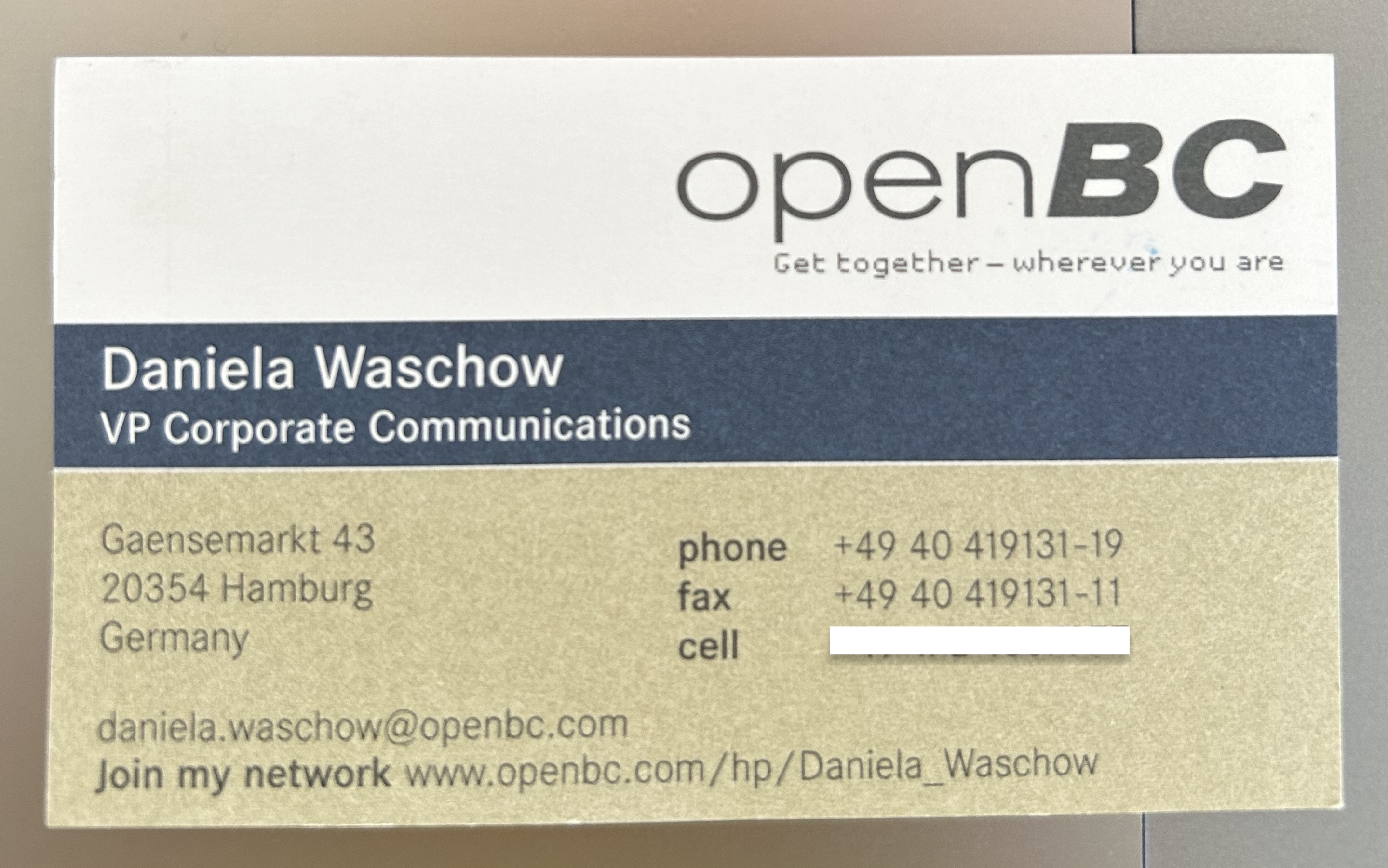
Daniela’s role, as she remembers it, was “everything that wasn’t coding”; it was also in large part about defining the company, building a brand and developing the frameworks that would help create and maintain scaleable, valuable communities. She explains, “back then, social networking wasn’t just about driving engagement, but about fostering social interaction and communication.
Starting with the people we knew, getting them to invite others, getting good people to bring other good people created a social environment that people wanted to be part of. Of course, we shouldn’t underestimate the fact that this was a social environment which helped people make money, another important pull factor!”
Understanding the social mechanics and codes which underpin business relationships was crucial to the platform’s success. “We promoted business relationships based on trust, online and offline…we understood the importance of social conventions in digital spaces, and worked hard ensuring these were built-in to the platform.
We had members blogging about how to behave on, as well as use, the platform, a community creating conventions that also expanded into the real world and which ensured a degree of value in, value out. There was a feeling among users that it was a collaborative exercise, that they – and we – were building something together, and this aspect of the brand was vital to our growth and success.”
“Back then, social networking wasn’t just about driving engagement, but about fostering social interaction and communication."
Daniela Hinrichs
‘Netiquette’ is a quaint term in 2025, but developing a strong sense of behavioural norms for online life was central to the success of the platform. As Daniela recalls, “We realised that taking network building online was going to be a paradigm shift and that we needed to set things up to accommodate that – so we created group moderators, we had netiquette guidelines, and we had a genuinely best-in–class community management team whose work was fundamental to our success. Whenever we had red flags around behaviour, we acted on those – we called people up when they broke the rules! This was a community focused on work, remember – real names, real photos – so there was a degree of professionalism baked in, a set of values inherent in people’s expected behaviour.”
By 2006, the “Open Business Club” label felt too literal and, increasingly, misleading. The word “open” suggested data might be exposed, and the “club” sounded closed and parochial. The company needed a brand that could travel. After weeks of naming work, they landed on XING – a name that hinted at people “crossing paths”. In practical terms, the rebrand was a high-wire act: around 1.5m member profiles and some 42m peer-to-peer connections were migrated to the new identity without losing a single link.
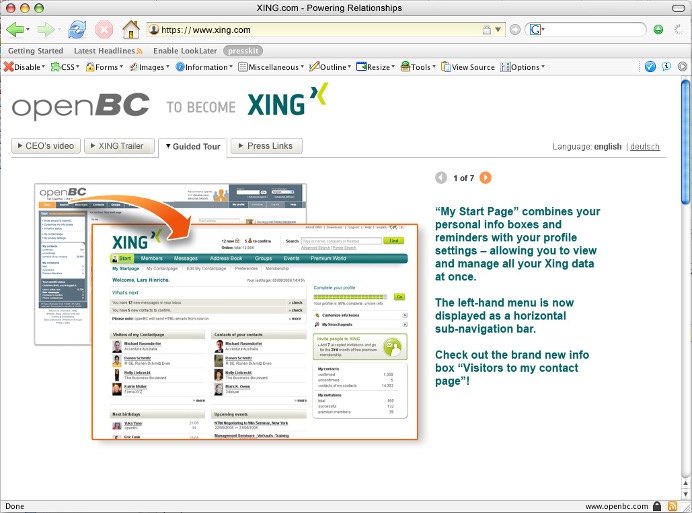
The timing was deliberate. Just weeks later, on 7 December 2006, the company – by then officially XING – went public in Frankfurt, the first Web 2.0 company to list on a stock market anywhere in the world, and it did so as a profitable, subscription-led business rather than a speculative bet on future advertising. The issue price of €30 per share implied a valuation of roughly €175 million and raised around €35.7 million, a striking vote of confidence in a category that barely existed a few years before.
Behind those headlines were the numbers that mattered more internally. By December 2006, XING had 1.69 million members worldwide, including more than 220,000 paying premium subscribers – an unusually high share of paying users for any social platform at the time – and had generated €10.1 million in revenue that year. Within another twelve months, the member base would pass five million and revenues almost double again, supported by a growing network of offices from Hamburg and Zurich to Barcelona, Istanbul and Beijing.
“We wanted people to benefit from connections"
Daniela Hinrichs
Daniela’s involvement ended when the founder’s decision to sell his stake in the company made it feel like a natural time to close that chapter and start another entrepreneurial journey. Yet she still speaks of XING with pride, and reflects that “the future you want for your social network will be true.
We wanted people to benefit from connections, to share knowledge, to be proud of their work and their achievements, to give them a space to benefit from social and economic networks, to build a focused, well-moderated platform for people with great intentions.
It was a pioneering job, needing not just the state of the art technical solutions, but a strong user experience from a content and community point of view. We built that, which is why the company was, and still is, successful, and I am proud to have been a seed investor and crucial part of what was a truly game-changing concept and business.”
Key Facts: XING (formerly openBC)
- Founded: August 2003 (Hamburg, Germany)
- Founders: Lars Hinrichs (Founder/CEO), with Daniela Hinrichs as early executive and co-builder.
- Rebranded: November 2006 (from openBC to XING)
- IPO: December 7, 2006 (Frankfurt Stock Exchange)
- IPO Milestone: World’s first Web 2.0 company to go public.
- Key Financials (2006): €10.1 million in revenue; profitable from inception
- Market Cap (End of 2006): Approx. €160 million.
- Reach: Operating in 16 languages with over 1.5 million members migrated at the time of rebranding.